


My co-pay for ENHERTU is too high. How can you help me?
The ENHERTU Patient Savings Program is available for commercially insured patients. The goal of the program is to remove cost as a barrier for eligible commercial patients by assisting with their out-of-pocket costs for ENHERTU. Talk to your doctor to sign up for the program or call ENHERTU4U at 1-833-ENHERTU (1-833-364-3788).
I cannot afford ENHERTU. What are my options?
There may be options to help you get ENHERTU. ENHERTU4U can refer you to patient assistance options such as the patient savings program, Patient Assistance Programs (PAP), and independent foundations.
My health plan denied coverage for ENHERTU
We have resources to help your doctor file an appeal. Your doctor’s office will need to file an appeal directly with your health plan. Have your doctor visit ENHERTU4U.com or call 1-833-ENHERTU (1-833-364-3788).
I no longer have or do not have health insurance. What do I do?
If you cannot afford your medicine, you may be able to get help from our Patient Assistance Programs (PAP). PAP can provide ENHERTU for free if you qualify. Eligibility rules apply. Please click here for more information regarding eligibility.
To understand insurance coverage, the following key terms will be helpful.
Brand-name drugs
Drugs marketed under a trade name by the manufacturer that develops and patents them.
Generic drugs
Once the patent (or license) expires on a brand-name drug, a generic chemically equivalent version can be developed and sold at a lower cost.
Premium
Payments made by patient to maintain insurance coverage. This is a monthly payment and varies by insurance plan.
Co-payments (Co-pays)
The set fee patients pay for a covered service every time that service is provided. Co-payments vary depending on the plan. Co-payments do not count toward a deductible but do count toward the annual out-of-pocket maximum for most services. Nearly all plans have co-payments or co-insurance.
Co-insurance
The percentage of the cost the patient pays for a covered service. Co-insurances vary according to the plan and do not apply toward deductibles. However, they do count toward the annual out-of-pocket maximum for most services.
Deductible
The set amount patients must pay each contract year for covered medical services before the insurance plan begins to pay its share. Patients with a deductible will be billed for the full allowable amount for each service that is subject to the deductible.
There are two types of health insurance, private and public. Private, or “commercial” health insurance is insurance you get from your job, or insurance you buy directly from an insurance company or exchange.
Public health insurance is provided by the federal or state government. This includes Medicare, Medicaid, Veterans Health Administration/TRICARE Department of Defense.
Private and public health insurance both include the medical benefit and the pharmacy benefit.
Medical benefit
Typically covers physician and hospital services for things like visits to the doctor, drugs administered by doctors, hospital services and supplies, and some home health services.
Pharmacy benefit
Typically covers prescription drugs taken by mouth, and self-administered injectable prescription drugs that are used at home.
Understanding Medicare
Medicare mainly provides coverage for people who are over the age of 65, blind, or disabled. This program pays for medical services and procedures that have been determined as “reasonable and necessary.” It is important to note that there are various parts of Medicare and benefits vary based on the type of coverage you select.
Medicare Part A
Hospital Insurance
Covers inpatient hospital services and certain follow-up care.
Medicare Part B
Medical Insurance
Covers medically necessary services and supplies. Also covers drugs prescribed and administered by a healthcare provider.
Medicare Part C
Medicare Advantage
Covers part A and part B benefits, and could also include prescription coverage.
Medicare Part D
Medicare Prescription Drug Coverage
These are private insurance plans specifically for prescription drug coverage.
Medicaid
Covers people with low incomes and some disabled people. Funded partly by the federal government and partly by individual states.
Veterans Health Administration/TRICARE DoD (Department of Defense)
Covers people who are or have been in the military, including:
- Veterans
- Active-duty service members
- National Guard and Reserve members
- Retirees
- Families of retirees
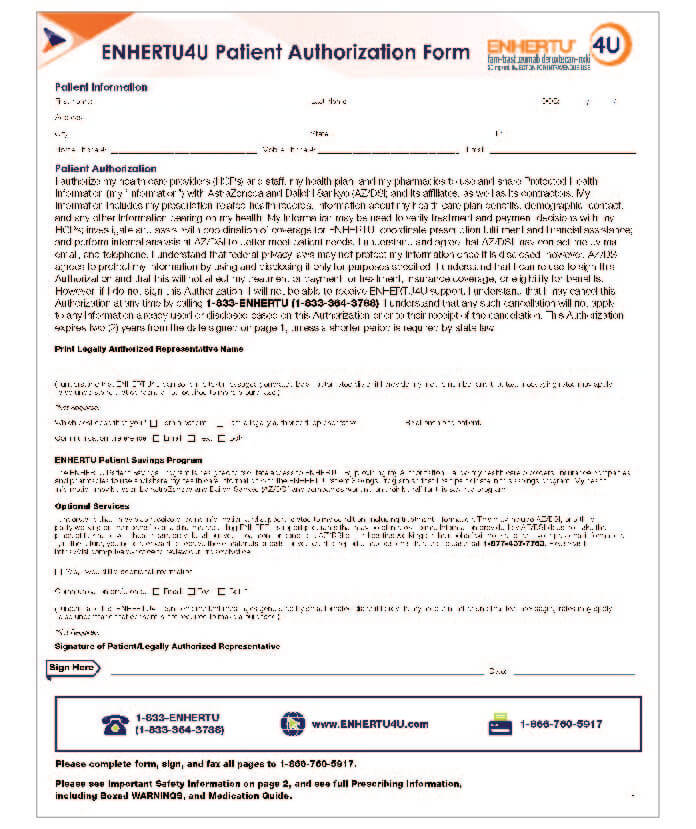
In order for you to receive ENHERTU4U program offerings, your doctor will complete an enrollment form. If you did not sign this form at your doctor’s office, you can give authorization in 1 of 3 ways:
- Call ENHERTU4U at 1-833-ENHERTU (1-833-364-3788) to give authorization over the phone
- Print the form below and fax it to 1-866-760-5917
- Provide completed form to your doctor and they will send it to ENHERTU4U
ENHERTU4U: Patient Access to Treatment
1-833-ENHERTU (1-833-364-3788)Important Safety Information
What is the most important information I should know about ENHERTU?
ENHERTU can cause serious side effects, including:
- Lung problems that may be severe, life-threatening or that may lead to death. If you develop lung problems your healthcare provider may treat you with corticosteroid medicines. Tell your healthcare provider right away if you get any of the following signs and symptoms:
- cough
- trouble breathing or shortness of breath
- fever
- other new or worsening breathing symptoms (such as chest tightness, wheezing)
- Low white blood cell count (neutropenia). Low white blood cell counts are common with ENHERTU and can sometimes be severe. Your healthcare provider will check your white blood cell counts before starting ENHERTU and before starting each dose. Tell your healthcare provider right away if you develop any signs or symptoms of an infection or have fever or chills during treatment with ENHERTU.
- Heart problems that may affect your heart's ability to pump blood. Your healthcare provider will check your heart function before starting treatment with ENHERTU and during treatment if needed. Tell your healthcare provider right away if you get any of the following signs and symptoms:
- new or worsening shortness of breath
- coughing
- feeling tired
- swelling of your ankles or legs
- irregular heartbeat
- sudden weight gain
- dizziness or feeling light-headed
- loss of consciousness
Your healthcare provider will check you for these side effects during your treatment with ENHERTU. Your healthcare provider may reduce your dose, delay treatment or completely stop treatment with ENHERTU if you have severe side effects.
- Harm to your unborn baby. Tell your healthcare provider right away if you become pregnant or think you might be pregnant during treatment with ENHERTU.
- If you are able to become pregnant, your healthcare provider should do a pregnancy test before you start treatment with ENHERTU.
- Females who are able to become pregnant should use effective birth control (contraception) during treatment with ENHERTU and for 7 months after the last dose.
- Males who have female partners that are able to become pregnant should use effective birth control (contraception) during treatment with ENHERTU and for 4 months after the last dose.
Before you receive ENHERTU, tell your healthcare provider about all of your medical conditions, including if you:
- have lung or breathing problems
- have signs or symptoms of an infection
- have or have had any heart problems
- are breastfeeding or plan to breastfeed. It is not known if ENHERTU passes into your breast milk. Do not breastfeed during treatment with ENHERTU and for 7 months after the last dose.
Tell your healthcare provider about all the medicines you take, including prescription and over-the-counter medicines, vitamins, and herbal supplements.
How will I receive ENHERTU?
- You will receive ENHERTU into your vein through an intravenous (IV) line by your healthcare provider.
- For the treatment of early breast cancer:
- Before surgery, ENHERTU is given 1 time every three weeks (21-day treatment cycle) for 4 cycles followed by THP for 4 cycles.
- After HER2-targeted treatment and surgery, ENHERTU is given 1 time every three weeks (21-day treatment cycle) for 14 cycles.
- For the treatment of metastatic breast cancer, HER2-mutant non-small cell lung cancer, gastric cancer or other HER2-positive solid tumors:
- ENHERTU is given 1 time every three weeks (21-day treatment cycle).
- Your healthcare provider will decide how many treatments you need.
- Your healthcare provider will give you medicines before your infusion to help prevent nausea and vomiting.
- Your healthcare provider may slow down or temporarily stop your infusion of ENHERTU if you have an infusion-related reaction, or permanently stop ENHERTU if you have severe infusion reactions.
- If you miss a planned dose of ENHERTU, call your healthcare provider right away to schedule an appointment. Do not wait until the next planned treatment cycle.
What are the possible side effects of ENHERTU?
ENHERTU can cause serious side effects. See "What is the most important information I should know about ENHERTU?"
The most common side effects of ENHERTU, when used alone at the 5.4 mg/kg dose in people with HER2-positive, HER2-Low and HER2-Ultralow breast cancer, HER2-mutant non-small cell lung cancer, and other HER2-positive solid tumors include:
- low white blood cell counts
- nausea
- low red blood cell counts
- feeling tired
- low platelet counts
- increased liver function tests
- vomiting
- hair loss
- constipation
- low levels of blood potassium
- decreased appetite
- diarrhea
- muscle or bone pain
The most common side effects of ENHERTU when used alone at the 5.4 mg/kg dose followed by THP, in people with HER2-positive stage II or stage III early breast cancer, include:
- low red blood cell counts
- increased liver function tests
- low white blood cell counts
- nausea
- inflammation of the nerves causing numbness, weakness, tingling or burning pain of the arms and legs
- diarrhea
- hair loss
- feeling tired
- rash
- muscle or bone pain
- low levels of blood potassium
- constipation
- vomiting
- sores in or around your mouth
- decreased appetite
The most common side effects of ENHERTU, when used in combination with pertuzumab at the 5.4 mg/kg dose in people with HER2-positive metastatic breast cancer include:
- low white blood cell counts
- low red blood cell counts
- nausea
- increased liver function tests
- diarrhea
- low platelet counts
- low levels of blood potassium
- feeling tired
- hair loss
- vomiting
- upper respiratory tract infection
- constipation
- decreased appetite
- weight loss
- COVID-19
- muscle or bone pain
- increased levels of blood bilirubin
- stomach pain
The most common side effects of ENHERTU, when used alone at the 6.4 mg/kg dose in people with HER2-positive gastric or GEJ adenocarcinoma, include:
- low red blood cell counts
- low white blood cell counts
- low platelet counts
- nausea
- decreased appetite
- increased liver function tests
- feeling tired
- diarrhea
- low levels of blood potassium
- vomiting
- constipation
- increased levels of blood bilirubin
- fever
- hair loss
ENHERTU may cause fertility problems in males, which may affect the ability to father children. Talk to your healthcare provider if you have concerns about fertility.
These are not all of the possible side effects of ENHERTU. Call your doctor for medical advice about side effects. You may report side effects to Daiichi Sankyo at 1-877-437-7763 or to FDA at 1-800-FDA-1088.
What is ENHERTU?
ENHERTU is a prescription medicine used to treat adults with:
- Human epidermal growth factor receptor 2 (HER2)-positive stage II or stage III early breast cancer followed by a taxane, trastuzumab and pertuzumab (THP) before surgery. Your healthcare provider will perform a test to make sure ENHERTU is right for you.
- HER2-positive breast cancer that cannot be removed by surgery or has spread to other parts of the body (metastatic) in combination with pertuzumab as your first treatment. Your healthcare provider will perform a test to make sure ENHERTU in combination with pertuzumab is right for you.
ENHERTU alone is a prescription medicine used to treat adults with:
- HER2-positive early breast cancer who have received trastuzumab (with or without pertuzumab) and taxane-based treatment before surgery and have cancer remaining in the tissue removed during surgery.
- HER2-positive breast cancer that cannot be removed by surgery or that has spread to other parts of the body (metastatic), and who have received a prior anti-HER2 breast cancer treatment:
- for metastatic disease, or
- have breast cancer that has come back during or within 6 months of completing treatment for their early-stage breast cancer.
- HER2-low breast cancer that cannot be removed by surgery or that has spread to other parts of the body (metastatic), and who have received a prior chemotherapy:
- for metastatic disease, or
- whose disease has returned during or within 6 months of completing adjuvant chemotherapy (after surgery). Your healthcare provider will perform a test to make sure ENHERTU is right for you.
- Hormone receptor (HR)-positive, HER2-low or HR-positive, HER2-ultralow breast cancer that cannot be removed by surgery or that has spread to other parts of the body (metastatic), and who have received one or more endocrine treatments for metastatic disease. Your healthcare provider will perform a test to make sure ENHERTU is right for you.
- non-small cell lung cancer (NSCLC) that has a certain mutation in the HER2 gene and cannot be removed by surgery or has spread to other parts of your body (metastatic), and who have received a prior treatment. Your healthcare provider will perform a test to make sure ENHERTU is right for you.
- ENHERTU was FDA approved for this use based on a clinical study that measured how many patients responded and how long they responded. ENHERTU is still being studied to confirm these results.
- stomach cancer called gastric or gastroesophageal junction (GEJ) adenocarcinoma that is HER2-positive and has spread to areas near your stomach (locally advanced) or that has spread to other parts of your body (metastatic), and who have received a prior trastuzumab-based regimen.
- solid tumors that are HER2-positive (IHC 3+) and that cannot be removed by surgery or have spread to other parts of your body (metastatic), and who have received a prior treatment and have no other satisfactory treatment options. Your healthcare provider will perform a test to make sure ENHERTU is right for you.
- ENHERTU was FDA approved for this use based on clinical studies that measured how many patients responded and how long they responded. ENHERTU is still being studied to confirm these results.
It is not known if ENHERTU is safe and effective in children.
Please see full Prescribing Information, including Boxed WARNINGS, and Medication Guide.